Up to 24 cash back Item 36 refers to the following diagram 35. Legal validity and the sources of law.
Natural
It is a system of rules established by the governmental power of a state.
. Igm of positivism examining its definition history and assumptions ontology epistemology axiology methodology and rigor. The term positivism is derived from Latin ponere positum meaning to put. The basic affirmations of positivism are 1 that all knowledge regarding matters of fact is based on the positive data of experience and 2 that beyond the realm of fact is that of pure logic and pure mathematics.
Positive law has as its purpose the common good of the community. Aquinass way of stating this point. The area of AOB is A Sr 5 1 B Sr 5 2 C 2 5 1 Sr D 2 5 2 Sr C Item 36 refers to the following diagram.
Obviously the locution from a moral perspective needs to be filled out by any credible theory of law. Legal positivism believes that law is a closedshow more content. For generations Congress has used the term positive law when it enacts a title of the Code as such into statutory law.
AOB is a sector of a circle such that angle AOB 72 and OB is r units long. Positive law is that which is man-made ie defined formally. For example section 1 of the Act of July 30 1947 1 USC.
Legal positivism is a philosophy of law that emphasizes the conventional nature of lawthat it is socially constructed. According to legal positivism law is synonymous with positive norms that is norms made by the legislator or considered as common law or case law. Theories on legal jurisprudence and the morality of laws.
It is possible that L is a law even if L is deeply flawed from a moral perspective. Positive law is law made by man. Positivism is aligned with the hypothetico-deductive model of science that builds on verifying a priori hypotheses and experimentation by operationalizing variables and measures.
Refers to the likelihood that one twin will develop similarly to another twin. Legal Positivism Law and Legal Definition. Legal positivism is the view that law is fully defined by its existence as man-made law.
Solve the amazing and exhaustive quiz containing the questions for major portion of Jurisprudence for All India Bar Examination. The answer is always there to be found if the judge. The merits of a law are a separate issue.
B An objective norm that has to be followed in the interest of order in society. Hence not only is there no moral obligation to obey it but there is no legal obligation to obey it either. 1 provides in relevant part.
Is expressed as a percentage. In contrast to natural law. Results from hypothesis testing are used to inform and advance.
Is intended to maintain the status quo in. In the positivist opinion the source of a law is the establishment of that law by some legal authority which is recognised socially. Legal positivism faces a third challenge- morally bad laws.
Hart a soft positivist thinks that judges exercise their discretion in reaching a solution that fills the gap thereby creating law. In the figure above O is the centre of a circle of radius 10 cm and angle AOB is 36. This quiz and worksheet will test you on.
On contrary Dworkin a hard positivist believes that the law never runs out. Customary law is thought to emerge spontaneously from below while positive law is thought to be deliberately imposed from above. Any positive law which conflictsis inconsistent with either natural law or divine law is not really law at all.
Title 1 of the United States Code entitled General Provisions is codified and enacted into positive law. Legal positivist views on what governs our behavior. Natural Law Theory NLT.
1 The Natural Law School as propounded by Salmon claims that positive law derives its standard from. Question 1 4 4 pts Biological positivists assume that the law. The best example is the Nazi regime in Germany where Hitlers words became above all laws.
What legal positivists view as an. The theory of positive law cannot be understood except by contrast with two other kinds of law. Legal positivism refers to a school of thought in philosophy of law and jurisprudence that the existence and content of law depends on social facts and not on its merits.
According to positivist thesis whether a society has a legal system depends on the presence of certain structures of governance and not on the extent to which it satisfies. A school of Jurisprudence whose advocates believe that the only legitimate sources of law are those written rules regulations and principles that have been expressly enacted adopted or recognized by a governmental entity or political institution including administrative executive legislative and judicial bodies. Legal Positivism considers good law as the law that is enacted by proper legal authorities following the rules.
Formal criteria of laws origin law enforcement and legal effectiveness are all sufficient for social norms to be. The main feature of the regime included racism in which millions of Jews and other races who were not in the branch of the Aryan race were murdered in the Holocaust. What is the length.
Positive law can be based upon natural law but generally this view of law is opposed to the classical understanding of natural law. Question 2 4 4 pts Which of the following theorists is often called the father of. Natural Law considers good law as the law that reflects natural moral order through reason and experience.
Natural Law holds that law should reflect moral order. It may be a bad law by some. In contrast to customary law positive law is said to be posited or imposed.
It is not possible that L is a law if L is deeply flawed from a moral perspective Harts Concept 156. Legal Positivism holds that there is no connection between law and moral order.
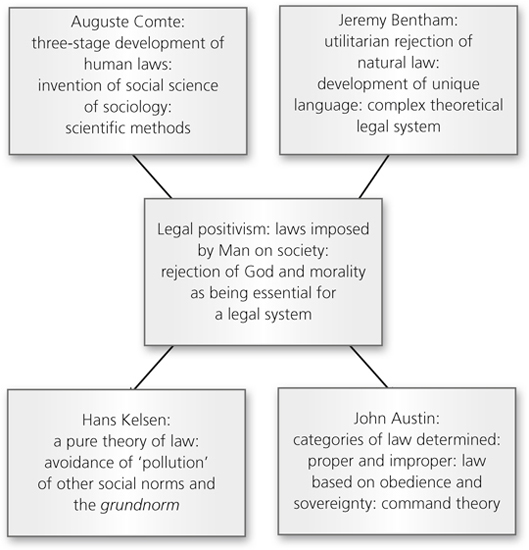
Early Legal Positivism
1
3
Hart Legal Positivism



0 Comments